The 7 Most Common Tax Mistakes Small Business Owners Make
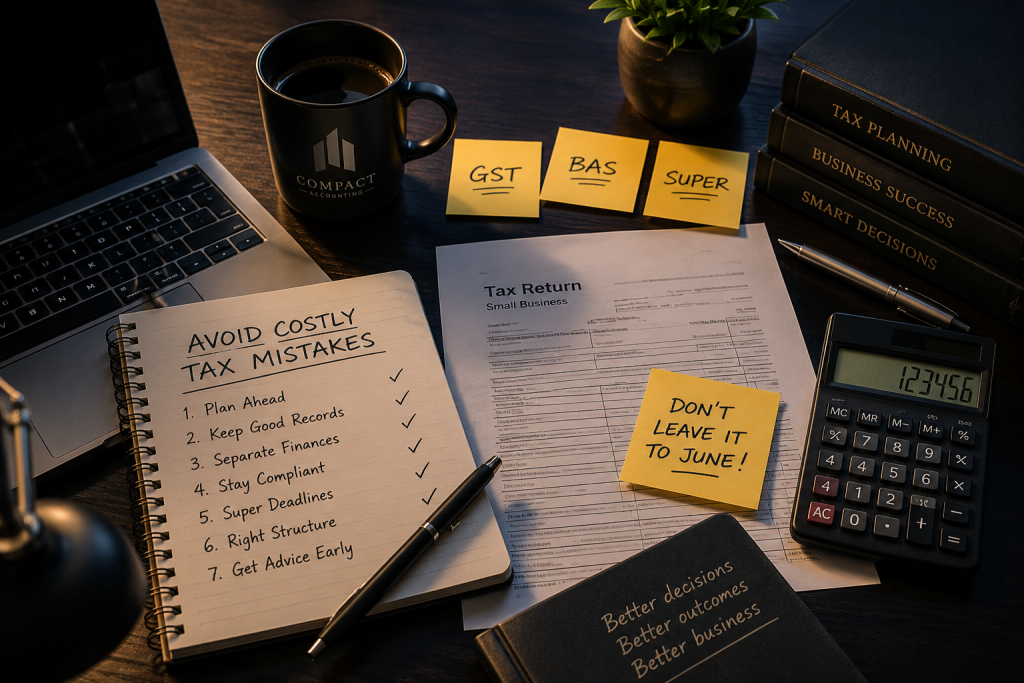
Even well-run businesses can make simple tax mistakes that lead to unnecessary costs, missed opportunities or unwanted attention from the ATO. Here are seven common issues we regularly see—and how you can avoid them
Mistake 1 – Waiting Until June to Plan
Many business owners only think about tax in the final weeks of the financial year. Unfortunately, by then many opportunities have already passed.
Reviewing your position throughout the year allows time to consider deductions, superannuation contributions, asset purchases and cash flow before decisions become rushed.
Things to consider
✓ Review your business performance regularly.
✓ Meet with your adviser before year-end.
✓ Don’t leave tax planning until the last minute
Mistake 2 – Poor Record Keeping
Accurate records make preparing tax returns, BAS and financial statements significantly easier.
Incomplete records can lead to missed deductions, unnecessary accounting costs and additional ATO queries.
Good habits include
✓ Keeping receipts and invoices.
✓ Reconciling bank accounts regularly.
✓ Maintaining up-to-date bookkeeping.
✓ Storing documents electronically.
Mistake 3 – Mixing Business and Personal Expenses
Using one bank account for everything creates unnecessary confusion.
Separate accounts improve reporting accuracy and make identifying deductible expenses much easier.
Best practice
✓ Separate business banking.
✓ Separate credit cards.
✓ Avoid paying personal expenses from business accounts.
Mistake 4 – Ignoring GST and BAS Obligations
Late or inaccurate BAS lodgements can create cash-flow pressure and attract penalties.
Understanding your GST obligations early helps avoid unpleasant surprises.
Review
✓ GST coding.
✓ BAS due dates.
✓ PAYG obligations.
✓ Cash flow for upcoming liabilities.
Mistake 5 – Missing Superannuation Deadlines
Superannuation must generally be received by the fund before the relevant deadlines to obtain a tax deduction.
Leaving contributions until the last few days of June can be risky.
Remember
✓ Contribution caps.
✓ Payment timing.
✓ Super Guarantee obligations.
Mistake 6 – Choosing the Wrong Business Structure
The structure that suited your business when you first started may no longer be appropriate as profits increase or circumstances change.
A periodic review may improve tax outcomes and provide greater flexibility.
You may wish to review your structure if
✓ Profits have grown.
✓ You’re employing staff.
✓ You’ve purchased investment assets.
✓ Succession planning is becoming important.
(Internal link: Choosing the Right Business Structure)
Mistake 7 – Not Seeking Advice Early Enough
Professional advice often costs less than fixing avoidable mistakes.
Discussing major decisions before acting can save considerable time, tax and stress later.
Key Takeaways
- Review your tax position throughout the year—not just in June.
- Maintain accurate and timely financial records.
- Separate business and personal finances.
- Understand your GST and superannuation obligations.
- Review your business structure as circumstances change.
- Seek advice before making significant financial decisions.
Need advice tailored to your circumstances?
If you’re unsure how these strategies apply to you or would like tailored taxation, business advisory or SMSF advice, Compact Accounting would be pleased to help.
General Information Only
This resource provides general educational information and does not constitute personal taxation, accounting, legal, financial product, investment or lending advice. It does not take into account your particular circumstances.
Tax outcomes depend on the relevant facts, applicable law and timing. You should obtain appropriately qualified professional advice before acting or refraining from acting on this information.
Reading this resource or contacting Compact Accounting does not, by itself, create an accountant–client relationship. Any engagement is subject to our written acceptance and agreed scope of services.
Liability limited by a scheme approved under Professional Standards Legislation.
References & Further Reading
- Australian Taxation Office — Record keeping for business
- Australian Taxation Office — GST and BAS for business
- Australian Taxation Office — Super for employers
- Australian Taxation Office — Business structures: key tax obligations
First Published: 4 July 2026
Last Reviewed: 29 July 2026